Wednesday, July 14, 2021

Cooking up lessons with family in Last Super Chef

All my readers!

My Reading trail has reached another home away from home. A new favorite book for 2021! Chris Negron's 2nd book and newest book The Last Super Chef! Master Chef Junior mixes well with ingredients from other kids cooking shows shirt in some new human family Aesops fables and you've got a yummy and moving masterpiece, sure to leave readers with full hearts. This sophomore book is a perfect foodie middle grade focused on family, a recipe of heart lessons and a few no recipe plot twists based in an unscripted quirky cooking competition TV show. The books after taste is exquisite and the story is sure to fill the appetite of readers of all ages.

Please Read DONT SCROLL to the end to get some of the authors favorite, book inspired exclusive Recipes!


Please buy the book at this link https://www.booksinc.net/book/9780062943132

or buy a signed copy at Books Inc Palo Alto https://www.booksinc.net/PaloAlto

While supplies last!


Hannah Walcher and Books Inc and I had an awesome event with him and Debra Green recently and the link is below!

Full Video of Books Inc Event Summer Fun: Reading & Cooking & Writing Middle Grade with CHRIS NEGRON and DEBRA GREEN is here at this link https://youtu.be/RXguIVSuww4


Dated Books Inc Event Poster!!


Don't miss my previous interview with Chris Negron about his debut Dan Unmasked featured on my blog at this link http://worthyreader.blogspot.com/2020/07/dan-unmasking-heros-in-our-midst-today.html


Chis Negon Author photo

Recently I did a follow up interview with Chris Negron about his delicious new book Last Super Chef and more. Read this exclusive interview below as a follow up to the Books Inc exclusive event!


1. Please introduce yourself as a writer in your own words?

I’m Chris Negron and I write contemporary middle grade novels from Atlanta, GA. My work tends to be heartfelt and (mostly!) realistic about friendship or family or both. My first book, Dan Unmasked, came out in 2020 and my second, The Last Super Chef, was just released this month.


2. Describe your new book the Last Super Chef in your own words?


The Last Super Chef is a story about Curtis Pith, an eleven-year-old obsessed with cooking and becoming a chef. Curtis has a big secret: the most famous chef on the planet – the fabulous Super Chef himself, Lucas Taylor – is Curtis’s father. So when the Super Chef announces a final competition on his hugely popular show featuring only kid contestants, Curtis knows he must secure one of the slots – not just to win the big prize, but to find out some big truths as well. The competition proves to be a huge challenge to not only Curtis but alll the kid contestants, and they all learn a ton about themselves and the people around them, including each other.


Chris Negrons new book
showing signed copies at Books Inc Palo Alto!


3. Dan Unmasked is an amazing debut, Last Super Chef came out not far after Dan Unmasked, how did this happen with all the challenges in publishing?


There was always going to be second book in my contract, and it was scheduled from the beginning to publish the very next year, so I don’t think I had much choice! Seriously, the better answer is that I was able to start working on The Last Super Chef as far back as when Dan Unmasked was on submission with publishers, so I had a real head start by the time that first book sold. It’s also true that Curtis’s – and the Super Chef’s – story was really clear to me right from the beginning, so I suppose that helped me know where I was going and prevented too much rework, though there always seems to be a ton of revision no matter what I do. Probably because my editor has such a sharp eye!


4. Describe your writing process for the new book and how that process compares to the process for Dan Unmasked, your debut?


Second books are usually more difficult for authors – for must of us, it’s the first time we’re writing under those kinds of deadlines, plus we have bunches of new tasks we never had before related to the first book coming out. Things like working on marketing efforts, events, interviews, etc. All at the same time! That said, because I did have that head start, I didn’t find the second book as challenging as I’ve heard other authors talk about with theirs. Again I think it was probably partly due to how clear Curtis’s story was for me from the beginning.


Find Signed copies of both of Chirs Negron's
books at Books Inc Palo Alto


5. What inspired the characters? What inspired the plot? Why did you write this book in first person?


I keep saying Curtis’s story was really clear for me, but actually the first character I developed for this book was Lucas Taylor, the famous Super Chef. Lucas is connected to me in a personal way – I was diagnosed with Parkinson’s Disease not long before I started writing this book, and though we don’t find out that’s what’s going on with the Super Chef until pretty late in the story, it does turn out that he also has Parkinson’s. Of course that’s no coincidence, and I don’t treat it as a spoiler, either. First off, there are plenty of other secrets in The Last Super Chef, but also I always intended to use this book to expose folks to those early years of Parkinson’s – the confusion and the changes and doubts those of us experiencing it go through – so I do want it to be well-known that this book covers that subject, even if it means readers might see a thing or two coming.


As far as characters, Curtis came next, and the important thing about him is how he contrasts and at the same time mirrors the Super Chef’s changing viewpoint on his own future. So I had to have the Super Chef before I could find Curtis, but once I knew what was going on with Lucas Taylor, what was going on in the head of Curtis became clear fairly quickly. I mean, sort of…early drafts didn’t express it as well as I intended, and my editor really helped me zero in on Curtis’s goals and motivations.


As far as first person, I think that’s just my POV of choice in most of my work…for now, anyway. I’ve written both Dan Unmasked and The Last Super Chef that way because it’s the closest to the character I can get, and that’s how I want readers to feel when they read these books – as close to these characters as they can get. So hopefully I’ve used my POV choice for its purpose, and achieved that goal.


6. Why did you choose food, competition and family matters as the focuses of this book?


I’m a big sports fan, and maybe that’s why I like cooking competition shows so much – they’re almost like another kind of sport. But I’m also aware that it’s more than that, too. I love seeing people excel at an art – whether it be painting or writing or cooking– that forces them to be creative and express their unique voice and individuality. When I wrote Dan Unmasked, I committed myself to writing about things I love or that are important to me, because I feel that expressing those things via story is one of the best ways to be authentic and display my own unique voice. And being authentic is so important in any writing, but particularly with kids, because I think they sense a fake even fastser than adults do. So Dan loves comics and baseball, and Curtis loves cooking, but what I’m expressing there is a little more indirect, because honestly I don’t cook all that much. Yet I love watching these shows and seeing the competitors challenge each other and themselves to be the best they can be, and I think I wanted to see if I could deliver that feel I tend to experience on the page to others.


As far as family goes, I think most middle grade books are in some way about the kids trying to find their place in the world, whether that’s amongst their friends or in school, or within whatever family unit they are a part of. In Dan’s case, it was mostly friendship. In Curtis’s, it’s much more the family angle. I don’t remember where I first heard this quote, but it’s always stuck with me: “When thinking about YA and MG, think about your character approaching a lighthouse. In MG, the character’s family is the light in the sky, and the character is moving toward it. In YA, the character’s family is the rocks at the base, and the character is crashing against them.” That may not be accurate in the case of every story in these genres – YMMV, as they say – but that quote has always stuck with me, and I think, at minimum subconsciously, I keep in the back of mind when I work on these projects.


7. You have said various times that the Super Chef, Lucas Taylor, the leader of the book titles game show is a mix of Wily Wonka and Gordon Ramsey, how did you make and manage this mix so well?


First off, I re-read Charlie and the Chocolate Factory pretty early in the process, so that I wouldn’t just be relying on my childhood memories of Roald Dahl’s classic, or the movies, either. So I definitely had that story in my head when I was working, especially the early chapters, which are unabashedly a take on the early “golden ticket” motif. But at the same time I didn’t want to reproduce too much – I was definitely writing my own story, not retelling Dahl’s. So I mostly tried to give little hints that might be evocative of the reader experience with that classic story. The result is hopefully clear but subtle at the same time – the astute reader might notice little Easter eggs related to Willy Wonka’s character, like the glass elevator the Super Chef rides in his intro, the way the certificate each kid is handed as they earn their way into the competition is tinged in gold (nudge, nudge, wink, wink…golden ticket). Perhaps more obscurely, even the black-shirted assistants who appear out of nowhere to clear away things during the challenges might be sorta kinda similar to the orange oompa loompas? Is that one only in my head?


Gordon Ramsey was perhaps a little easier, because of how closely I was writing to competitive cooking shows, and he’s involved in so many of them – Master Chef, Hell’s Kitchen, and so on. But really the chef side of Lucas Taylor is an amalgam of the characteristics of a lot of famous chefs – as well as many not so famous people, including a little sprinkle of myself. I’m glad, however, to hear he rings true as the quintessential famous chef so many of us are familiar with from TV.


Preview YouTube video Summer Fun: Reading & Cooking & Writing Middle Grade with CHRIS NEGRON and DEBRA GREEN

Summer Fun: Reading & Cooking & Writing Middle Grade with CHRIS NEGRON 
and DEBRA GREEN


8. Super Chef Lucas Taylor goes from celebrity to vulnerable older man in such a moving way, what is the impact of that shift on our first person narrator Curtis Pith?


Wow, thanks for that comment. Of course that’s a big part of what I was hoping to do, but you never known if you’re accomplishing what you set out to convey or not. But yeah, for Curtis, and a lot of the characters in the book – adult and kid characters alike – the word I like to toss around and I’ve seen in some reviews is perspective. I think if there’s one thing this story can convey or make readers think about, I would hope it would be perspective. That would make me happy. And I know perspective can be a pretty broad topic – it can be perspective about the future, or about other people, or about your family, or yourself even. Whichever of these the story might make you think about – or all of them – the conversation about perspective is one I hope The Last Super Chef starts. The impact of what he learns about the Super Chef in Curtis can best be summed up as “perspective” I think as well


9. I consider Last Super Chef to be a wild mix of updated Aesop's fables mixed into the chaos of your own flavor of Master junior chef!  Sometimes the lessons are spelled out in the form of themes from cooking competitions other times through out the book there are more teachable moments which are much more subtle. How do you put in so many teachable moments and conversation starters into your books especially the Last Super Chef?


Again that’s so appreciated, but I tend to avoid words like “lessons” when talking about writing for kids. I think one of the worst things a kid-lit writer can be is overly didactic in our work. In my opinion, anyway, what we really want to be doing is asking questions and starting conversations, not providing answers or lessons. Half the time I don't know enough about what I’m writing about to give out answers about it anyway! There’s a quote by Joan Didion that I imagine most writers know but is pretty applicable here: “I write entirely to find out what I’m thinking, what I’m looking at, what I see and what it means. What I want and what I fear.” I think about that quote sometimes when I’m writing, and I hope what I’m conveying to young readers is something like, “This is something I think and wonder about a lot. What about you?” Or maybe also, “This is what Curtis went through and how he handled it – maybe sometimes well and sometimes not so well – have you guys ever experienced this or thought about what would you do if you did experience it? Does seeing the mistakes Curtis made or the victories he won help you with that?”


Here is an elusive recipe for a yummy treat Chosen and shared by Chris Negron inspired by a specific part of Last Super Chef!


10. What are the most spoiler free important takeaways from the new book?


Perspective, perspective, perspective! I know, I know, I talked about this one earlier. Probably the other thing (which is still perspective related) is expectations of the future, being flexible and understanding that life is a wave we ride, and we’re not always going to be able to predict its flow. So keeping your knees bent and going where that surf takes you – while still having dreams and striving and fighting for them, dreams are so important – can be the happiest way to stay up on the board the whole ride. 


Visit Chris Negrons website!

https://chrisnegron.com/


11. What are you working on next? Any parting words?


I’m working on another middle grade novel but it’s very early in the process. It’s about a character who’s very protective of and

involved with his city neighborhood, and I don’t think I want to say much more about it, for fear of jinxing it or pitching it poorly! But I’m really excited about it and hope I can bring it to readers in the near future (which, in the publishing world…might be a year or two, but stay tuned)!


I’m just so thankful to you, Drew, for all your support, and likewise to Books Inc. and all the other Indie bookstores and booksellers for everything you do to put our stories into the hands of young readers who might need them or who they might touch.


Gratitude, thanks and appreciation and links are below! Thanks for reading! Keep on your reading adventures!


Thank you to! Books Inc, Chris Negron, Debra Green. Harper Kids Publishing and Holiday House Publishing!


Friday, February 12, 2021

Everything i Thought I knew, I love now!! You will too!

Hey Worthy and Eager readers!


Everything I thought I knew by Shannon Takoka is the perfect Valentines day love filled, romantic Novel for even the youngest Young Adults to any elder person! A mix of Pacific ocean, motorcycles, California Coast, love and danger, surfing, more then a few mind tricks, a transplanted heart, waves of the mind and flows of hearts, a beyond philosophical, luck, bad luck, carving out wave tunnel into a marvelous and indelible story that will have all readers have all the feels in ways that will leave their hearts yearning or and discovering whats real within their own feelings.  Maybe leaving more questions then answers for readers of all hearts. With all the possibilities, how much can we control? What is real? What is real love? Get your brain on board and read Everything I thought I knew before the waves go under! 


I was lucky enough to interview the books author Shannon Takoka! Interview is below! Her words are in bold and italics below.


Please buy the book at From books inc at https://www.booksinc.net/book/9781536207767


 Shannon, welcome to the Worthy reader blog!


1. Can you please introduce yourself and your debut book Everything I  thought i knew in your own words?


Everything I Thought I Knew tells the story of a 17-year-old girl named Chloe whose life is turned upside down by a heart transplant, and it causes her to question everything about who she is and who she wants to be.


2. You talk in a few of your interviews about the struggles writing  and completing the novel. What made your debut book so difficult?


Well, I guess like a lot of people who set out to write a book, I honestly wasn’t sure if I could do it! I’ve worked as a professional business writer for many years, but a full-length novel is an entirely different animal. So the entire process was a bit of trial and error for me. I’m more of a pantser than a plotter, so I discovered much of the story as I went along and it evolved a lot along the way. But that also means that sometimes I wrote myself into corners that I then had to find my way out of! Eventually, writing out of order helped get me unstuck. I ended up writing the ending before I had much of the middle and that was probably the best thing that could have happened since then I had something concrete to aim for. It was almost like putting together a puzzle. With my next book, I’m trying to reform my pantser ways a bit, so I have it a little more mapped out. But the best advice that I can give to aspiring writers is that there’s no “right” way to write a book – you need to figure out what makes the most sense for you.


3. How did you get your life, heart, mind and soul affirming story  into a published novel?


I think getting a novel published is a combination of things. Hard work and persistence matter a lot – you have to be willing to keep at it, to keep trying and learning and perfecting your craft, even if it takes a few books to get there. But there’s also a degree of magic and luck. The magic is the story idea that takes hold and I honestly can’t quite explain how that part works – it’s just really cool when I’m able to channel it. And there’s also just plain luck involved. The book business is sometimes all about the right editor getting your manuscript at the right time. Which is why I feel so lucky to have found an editor and agent that really “got” my story and worked really hard with me to make it the best that it could be.   


4. Chloe has so many struggles though out the book, which struggles  from the book do you think readers can relate to most? which of her struggles relates most to you when you were her age?


I think Chloe’s biggest struggle in the story is one that we all grapple with: Who do I really want to be? She’s really thrown into a position where she has to re-think all her assumptions about who she thought she was, at an age – that transition between high school and what comes after, between teen and adult – when figuring yourself out can be a little overwhelming. And I think that it’s okay to not always be sure. You don’t have to have everything figured out at age 17. Personally, I feel like the question of who we are is one we ask and answer again and again throughout our lives. We are always learning and hopefully evolving, and being shaped by our experiences.


5. Fragility and drastic change are motivators and plot pivot points through out the book for our narrator Chloe. There are so many changes Chloe experiences in layered ways, why did you choose this theme? Is change still a current moving in your life? If change is the only constant how do we get better at it?


I think I wanted to explore the idea that so much is out of our control and look at how we live with that. Change -- big and small, good and bad – is a constant and I think learning to accept it as a condition of our existence is a pretty important skill. We often define ourselves by what we are doing and accomplishing, and I think that’s natural, but what happens when the rug gets pulled out from under you? Although that can be terribly painful, I do think everything that happens to us gives us an opportunity to really think about who we are and how we want to live our lives.


Shannon Takaoka author photo!


6. In parts its hard to trust what is real for us as readers. Our dear Narrators heart transplant and the before and after is for some like me is more captivating and relatable then many books who have narrators with unchanged bodies. Why did you choose a heart transplant and What is it about the heart transplant that is most moving to you?


I once went to teaching hospital for my senior year Anatomy class and got to view open heart surgery and found it fascinating  – the fact that humans have figured out how to transplant a heart or a kidney or a lung, successfully, from one person to another is such an extraordinary achievement, and the history and science behind it all is so interesting. But I’ve also thought a lot about the emotional side of transplants: What does it feel like to know that a part of you – a part essential to keeping you alive – once belonged to someone else? I read and listened to a number of stories about transplant recipients and was struck by how some of them reported feeling deep connections to their donors – and it feels especially poignant when it’s a heart because of all the emotional connotations we typically associate with hearts.


7. Everything I thought i knew talks about inexplicable symptoms, the  unreliable truths of our bodies and other uncontrollable parts of our lives. What can these mysterious elements in your book reveal in the lives of your readers? If we experience many things we can't control  what do we have to hold on to in such a world as we have today?


In the story, I wanted to explore the tension between attempting to control our destiny and accepting the reality of fate and chance. Chloe is the kind of person who wants to understand the why of everything all the time, but there’s also something to be said for accepting the fact that not everything happens for a reason and not everything has an answer.


8. The flow of her feelings and the gripping attachment and the tides of all the feels of her more then an ocean crush with Kai reminded me of several reasons why I love my wife. Can you explain the swells of attraction and tide pulling of their hearts despite drift at the start and the darkening seas with storms breaking?


Well there something very powerful about the ocean isn’t there? And I loved the idea of these characters being pulled toward one another by almost a gravitational force – the same force that acts on the waves.


9. Are there any themes or messages you hope readers will take from Everything I Thought I Knew? Anything else you want to tell your readers?


I hope they take away that while life can be fragile and hard and unpredictable, there’s also so much beauty not to be missed. And while there’s nothing wrong with having goals and plans, I think we can also get so wrapped up in what comes next that we sometimes lose sight of the fact that life is lived in the present.


10. Whats next for you and your work?


I’m working on a new manuscript right now and I’m kind of superstitious about saying too much about a story while it’s still taking shape. But I can say that this one will also have a speculative element involving alternate realities.


What can we control? I love how even with the literal change of heart in your book, there is often intentional space made for ambiguity of control or lack of control. over scheduling and business seems to be the way we live.


Share your love and all that you know!


Please buy the book at Books Inc https://www.booksinc.net/book/9781536207767


Thank you to Shannon Takoka


and to Candlewick


and to Books Inc


Wednesday, October 14, 2020

When you Breathe, with Diana Farid


Eager and worthy readers! 


We are all going through a lot of stress, uncertainty, anxiety and a whole host of upsetting experiences these days, sometimes its hard to remember to breathe and step back and appreciate the fact that we can breathe and see, sense, and experience our breath mindfully and its flow through our consciousness and bodies! Even if our breathing is through masks! I recently interviewed author, physician and busy, busy, busy mom Diana Farid MD, we spoke of her picture book gem When You Breathe!

Buy the book here:

 https://www.booksinc.net/book/9781944903930


 Here is my interview with Diana Farid


  1. Please introduce yourself to our readers in your own words. What do you do besides write?


Hi everyone. I’m so excited to be able to be featured on Drew’s blog. Well what do I do besides write? Mainly I am a mom. I have four kids. They’re all in school, so right now as some of you are experiencing, they are all home. These days I spend a lot of my time getting snacks and meals ready, finding that science supply that went missing, the workbook under the pile of papers and being the IT expert for connecting online. When not being a mommy, I also work as a doctor, at the Stanford Vaden Health Center, taking care of Stanford University students. As a clinical assistant professor in Stanford’s department of medicine, I also work with medical students and the medical faculty integrating the arts and story into learning about medicine and promoting health concepts to the general public, especially through film. 


Author and mom Diana Farid


  1. Introduce your picture book when you Breathe in your own words? 


When You Breathe follows the magical journey of a breath from air to deep within the lungs of a little girl as she prepares to sing. It uses an upside down tree as a metaphor for imparting human biology concepts about the respiratory system and breathing. It uses poetry to ignite the imagination. It’s a testament to the power of breath and our connection to each other and the world. It’s science + poetry. And it’s gorgeously illustrated by fine artist Billy Renkl.


  1. Please explain the motivation and the writing process for this book for you? 


After the birth of my daughter, my first child, I remember feeling her breath touch my neck as I held her - that made me acutely aware of breath, the power of her future voice and my desire to teach her as much as I could about the wonder of our body’s workings. At the same time, while working as a physician, I noticed that my patients knew very little about how their bodies worked. For my youngest patients who could understand, especially ones who were having respiratory symptoms, I’d tell them the upside - down tree analogy/story and describe where their breath travelled to when they breathed. I found that it helped them understand their symptoms, feel more comfortable about what they were experiencing, my care and it helped them understand any treatments that I was recommending. About 10 years ago I started writing the poem that eventually became the book When You Breathe. It came out in bits and pieces as I took walks, watched my kids play in the yard, and thought about how I wanted to share the magic of breathing with children. After working on it for a number of years, it became what you see in When You Breathe.


  1. When you Breathe is the most precious picture book collection of poems that tells a narrative story of mindful breathing with purpose. The pictures are stellar and add new dimensions to the text. You told me that you have a professional friendship with the illustrator, how did this happen? 


Thank you so much for that generous description of the book. I feel the same about the illustrations. I didn’t know the illustrator, Billy Renkl, until recently. The publishing company, Cameron Kids, found him when they first noticed the art that he did for his sister’s adult non-fiction book. Billy and I got to meet this last winter at a children’s book writers and illustrators conference. We hit it off, especially connecting over our mutual awe with the science of human biology and how that overlaps with the wonder that art inspires. Since then, we’ve been able to support work around When You Breathe with a lovely collaborative spirit.


  1. The book is clearly crucial as a gentle reminder to take time to breathe and collect air to reconnect to our ever living, ever shifting universe. What made you choose few words to connect readers to mindful breathing as the vessel for such an important lesson for all ages? 


My intention was to impart to children that they are all wondrous, worthy,made of the same stuff as the stars (literally - here’s cool article about that: https://www.nationalgeographic.com/news/2015/01/150128-big-bang-universe-supernova-astrophysics-health-space-ngbooktalk/) and that we are all inextricably connected. I also know that human biology concepts are largely missing in early public education and I know that an entertaining introduction would be the most effective way of imparting the magic of breathing to young children- through the power of story, art and poetry. As a poet, I am fond of the least amount of words making a large impact, which drove the sparse text of the book.


  1. What are some of your favorite picture books and why?


The Dot by Peter Reynolds - I love the way it shows that if one stops judging one’s own art and lets it flow, truthfully, the process and result can be wonderful. I also love how it shows the potential power of supporting a child and valuing their expression.


Forever or a Day by Sarah Jacoby - It’s beautifully illustrated. I love how it is a thoughtful and poetic celebration of time - what can’t be seen or touched - but is still felt in so many ways.


The Undefeated by Kwame Alexander and Kadir Nelson - This is a vital picture book for all of us, folding poetry with Black history untold or denied with unstoppable illustrations. I hear a song , a hymn, when I read it. It begs to be read aloud, it celebrates what has risen from every attempt to subdue black lives, that there is more rising to come - and in the face of persistent attempts to defeat the recognition of one human family,  rising will persist.


  1. How can readers of all ages make this poetic meditation on breathing into more than just a brilliant story time and bedtime book? 


Oh, that’s a great question. One thing that’s great about the book is that there’s a glossary in the back that contains simple, digestible definitions of words that are related to our respiratory biology, air, and breathing. They offer a great gateway to exploring more about what each word means, how they relate to what we’re made of and how we live in the world. 


Even the first three lines that start the book are invitations for a reader to explore science concepts. For example: One could ask “What exactly is happening when the tree leaves sway? How does air actually move something? Or how does the leaf get energy from air? In the phrase about a bird flying, we could explore how flight takes place, how air moves around a wing to create lift. What is the structure of a bird wing? And then in that final phrase about music moving through air, we could explore concepts of sound waves with young children and hearing.There’s so much exploration that can springboard just from that spread alone. That’s really exciting to me. The book is a great cultivator of curiosity which can last well beyond while it’s read. For younger children the publisher and I have also created a few printable activity sheets that are a fun supplement to the book, which can be found on my website at dianafarid.com


In addition, fundamentally, the book sparks a wonder for breathing, the amazing things that take place in the seconds that we take a breath, the energy that we get from that breath, the pumping of our heart without us even thinking about it, moving that energy throughout our body and allowing us to do all the things that we want to do and be with all of the people and things that we love. So a reader can make more than just a good story time read by becoming more aware of their breathing. They can practice deep breathing a few times a day (I have a video about how to do this on my Youtube channel Diana Farid). They can also take action to be stewards of our environment, the air, and each other.


  1. Whats next for you as an author? Whats next for you professionally?


 Right now, I am revising a middle grave novel written in verse. I’m also working on drafts for potential follow up picture books to When You Breathe such as When You Sleep and When You See. I plan to also continue making films that bring audiences entertaining stories about health topics, right now these are available at my YouTube channel: Diana Farid.


  1. Do you have your own mindful connection practice? What is it? 


Some days I’m better at this than others. Sitting in silence, in a quiet space, and taking deep slow breaths, even if it’s just for a few minutes, can be powerfully centering for me. When I can’t do that, I find connecting to a piece of music that I really love, reading a poem or words of a spiritual teacher and meditating on its meaning, and being in nature, especially if it’s at an ocean shore or on a freshly snowed on mountain , reminds me of the things that I truly value in life. To me, being reminded of what’s important is the most powerful outcome of a mindfulness practice. I also shouldn’t forget to mention that a big source, before the pandemic, of mindful connection for me, was going to a music concert and connecting wholly to a song and the listeners around me - all being on the same amazing acoustic ride together. 


  1.  When you Breathe is an anchor, a foundational book for connection especially now during COVID.  Any parting words to our readers? Advice? Encouragement? 


There’s beauty in the workings of your breath and all the amazing functions of your body. I encourage readers to be curious about how their bodies work, to explore that curiosity with their children. Because when we all know more about the truth of our workings, we will be more prepared to keep ourselves whole and healthy, and able to critically evaluate what others might claim can keep us and our world beating. I hope the book can encourage us to see and celebrate each other’s light. And I hope it encourages us to recognize that like science, poetry and art should be embraced as fundamental ways to explore truth.


Please purchase the book here!!


Thank you to (with new window links)


Diana Farid,


Cameron Kids


Abrams Kids publishing,


Books Inc,


and all of my Worthy and Eager readers! Thank you all!

Wednesday, September 2, 2020

Ryan the Tiny Rex and the Tiny Team

Welcome back Eager  and worthy readers!  This post is dedicated to Ryan Thomas Durham, my son who turns 1 on Saturday! His party theme is Dinosaurs so I decided to interview the author and illustrator of the first two dinosaur books he ever had. Tiny T-Rex and the Impossible Hug and Tiny T Rex and the Very Very Dark!! I recently interviewed the T Rex creative team of illustrator Jay Fleck and author Jonathan Stutzman! Enjoy!


  1. Please introduce yourself in your own words. 


Jay: Hi, my name is Jay Fleck and I make picture books!  I’ve illustrated about 15 books over the past 15 years and also wrote one!


Jonathan: Hey everyone! My name is Jonathan and I write books for children. I’ve written a bunch of picture books and my first graphic novel series for young readers comes out next year!


Tiny T Rex and his mom and dad, Original print by Jay Fleck 


  1. Please explain how Tiny T. Rex came to be, especially how you chose the characters and how they came to life in words and art? Especially Tiny and his family? How about Pointy?


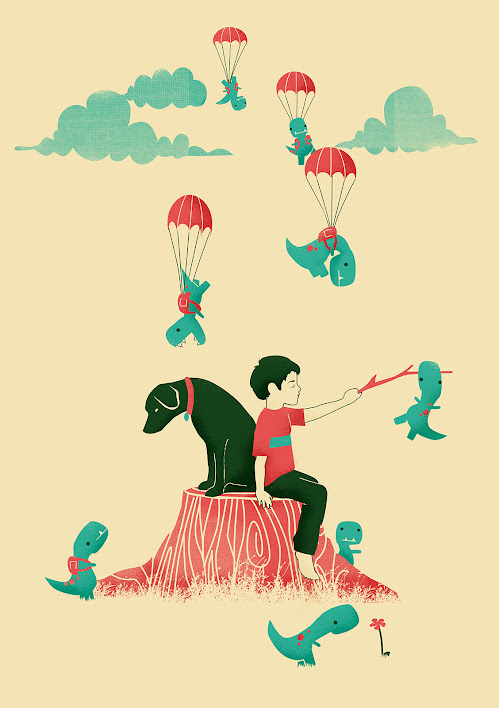
Jay: I think I came up with the name "Tiny T. Rex" before I even first drew the character.   I took out a pencil and drew a little t-rex with a big head and eyes, with a little body and of course tiny arms.  I tried to keep the shapes pretty simple with nice, pleasing lines and gave Tiny an endearing look that would make people smile.  Then I took that initial pencil sketch and refined it digitally.  The first full image was actually a big group of tiny t-rexes with little backpacks parachuting from the sky. 


Original Art by Jay Fleck

Jonathan: I felt so lucky to get a chance to write a story for Tiny! I loved Jay’s work and Tiny T. Rex is so cute! This was the first character that I wrote a story for that I had artwork FIRST before coming up with an idea, so I was working off of Jay’s art and trying to create a story that fit our big-hearted, small-armed dino. I think Jay, Chronicle, and I all felt that Tiny’s character (and size) would make a great jumping off point for telling stories about a dinosaur who faces a world much bigger than him with confidence, persistence, and most of all, kindness. So I felt trying to hug his best friend, Pointy (who is feeling down), would be a great way to introduce the character to encapsulate Tiny’s struggles and personality traits. We wanted to also have a life in the world for Tiny, so I wrote family and a best friend into the story, and Jay brought them to life wonderfully. The fun thing about a series is... the world of Tiny can keep growing!


Tiny T-Rex Book 1, The Impossible Hug

  1. What was the inspiration for Tiny specifically for each book? 


Jay:  With each book I’m sent the text from the publisher once it’s gone through multiple drafts and they and Jonathan are both satisfied.  Obviously as the illustrator I use that as my inspiration along with any notes for visual ideas that Jonathan might have.  


Jonathan: Essentially for each book we set a problem in front of Tiny and the humor and fun comes from seeing how Tiny uses his creativity and kindness to figure out how to overcome it. 

Tiny T Rex book 2 The Very Dark Dark


  1. Was any of the creative processes different for the Impossible Hug and The Very Very Dark? What inspired each story?


Jonathan: For me, sequels are a little more difficult to write. Because it’s a series, the books have to feel similar in tone, but I try my best to keep them fresh and surprising. Much of the fun of reading is about discovering, finding little surprises and wonders along the way even with characters and worlds we already know and love. 


Yours Drewly and Tiny Tex book 2 Tiny T Rex and the Very Dark Dark


  1. Explain how you collaborated on Tiny and his series? How did Tiny become a series? Any favorite behind the scenes moments or best outtakes?


Jay:  Tiny was actually developed from the start as a series.  Chronicle really liked the character and felt Jonathan and I would make a great team.  So we both signed on for a couple of books and went from there.  I really don’t have many outtakes.  The sketches for the three TINY books I’ve done so far are actually pretty close to the final versions, which isn’t true for most books I’ve worked on.  For some reason I’ve had a pretty clear idea for what I wanted to do with each book in this series from the start.   That’s probably a combination of Jonathan’s great work on the text and notes along with already having a pretty clear vision of the character in my own head.


Jonathan: It’s been so fun working with Jay! One of the best parts of making picture books is collaborating. I can write a page with something in my mind, but it really only comes alive when Jay illustrates it. It is a bit magical getting the art back and seeing Tiny, Pointy, and Auntie Junip (one of my favorites) all running around looking adorable in this world we created together. It’s so fun! I feel very grateful that I get to help create it with Jay, that Chronicle is letting us create it, and that it has found its way into the hearts of so many children. 


  1. Jay's Illustrations are cute, cartoony, artsy and perfect for Jonathan’s words. Explore how your mix of words and art make Tiny one of the best and most relatable Dinosaurs ever for kids of all ages and parents? 


Jay:  I can’t speak for Jonathan but my goal for Tiny was always to make him seem very lovable and approachable- just a kind, sweet character.  He has a big head and a small body and arms, and an array of endearing expressions.  He also has big ideas and is very determined, so not only can his cuteness make you smile but hopefully he also provides a little inspiration.  


Jonathan: The great thing with Jay’s art is that everything he mentions above about the character, Tiny’s sweetness and kindness, you can see on the page. For me, kindness was essential for not only Tiny’s look but his character. So that is definitely the core of Tiny. I think it was important to write a character that is both kind and had agency. I wanted Tiny to face those big obstacles headon with courage, perseverance, and intelligence. 


Tiny T Rex series creative team Jonathan Stutzman and Jay Fleck


  1. What do you want Tiny T Rex’s legacy to be? What would he tell today's readers both adults and kids? 


Jay: Simply put- I want TINY to help spread good vibes.  He’s a cute, compassionate little guy, we could all use a little more of that.  And while I don’t know what Jonathan has on the horizon story-wise, I'd like to flesh out his world and the other characters that surround him.


Jonathan: I definitely want children to be encouraged and empowered. It doesn’t matter how small a child is or what physical limitation they may have, they have agency. They can learn, try, be brave, and most of all, be kind.


  1. What are your relationships to Independent Bookstores? 


Jay:  I’ve done events with local bookstores and visit every local bookstore I can find when I’m travelling.  I love independent bookstores and was a little scared with everything happening that we might lose some.


Jonathan: Independent bookstores are incredible. I feel so blessed to have some close to my home, and to have so many indie booksellers support our Tiny series as well as my other books. Personally, indie bookstores are one of my favorite spaces to pop into. The books, the people, the smell of old and new stories… magic! I’ve definitely missed going in person during the quarantine. 


author Jonathan Stutzman and yours Drewly at Books Inc Palo Alto


  1. What keeps you creating gems of creativity for kids books despite all the evil, germs, apocalyptic elements and deadlines? 


Jay:  Illustration is escapism for me, when I put my head down and deep in work I’m not thinking about anything else.   And I hope that work brings a little positivity and light into the world.  If I can make a sweet, cute image and post it to social media and that makes even one person smile, it’s a good thing, especially now.


Jonathan: It’s definitely been difficult for me personally, but stories are one of those things that rise above everyday problems. You can see that with the lasting power of the stories that we’ve known since we were children. Stories are very human and essential to our DNA. I love the John Steinbeck quote, “But I have a new love for that glittering instrument, the human soul. It is a lovely and unique thing in the universe. It is always attacked and never destroyed”. I feel like that soul is also embedded in our stories, art, music... and how we share them with each other. It’s one of the things that keeps us hopeful and resilient even in the darkest times. 


  1. What other projects have you worked on together? Any collaborations currently scheduled? 


Jay:  TINY T-REX AND THE PERFECT VALENTINE comes out at the end of the year.  And then we have a couple more Tiny books that we’ll eventually work on.  After that, who knows what the future holds for Tiny!


Jonathan: Definitely more Tiny T. Rex!


Tiny T. Rex book 1 and 2 being devoured by Ryan Thomas Durham


  1. What’s next for you professionally as individuals?


Jay:  I will be making books for as long as I can!  Drawing cute pictures is probably the greatest job in the world.


Jonathan: I agree with Jay. I love writing and making books for children and I don’t ever want to stop. I feel incredibly grateful to be doing this and that children around the world can read these stories, find some joy and hope.


------------------------------


Big appreciation and gratitude to (with embeded links) Thank you to Jay Fleck, Jonathan Stutzman, Books Inc, Chronicle Books, Chronicle Kids Books, Hachette publishing, Books Inc Palo Alto and Kelly Costello Durham and of course Ryan Thomas Durham!